Now booking: collection runs from Weaverville down to Fletcher — start an estimate
Serving the Blue Ridge
Repair & Restoration

Rug Repair & Restoration in Asheville

Torn edges, missing fringe, moth grazing along the side that lives under the bed, spark burns down the hearth edge, a corner the puppy decided was a chew toy, or a rug that spent a night in river water. Most of it is fixable by hand.

Hand Work

Repairs That Disappear Into the Weave

Repair is reconstruction, not concealment. The weave is rebuilt from the foundation up, knot for knot at the density the loom set, in wool chosen against the original dye lot, so that the new ground ages on the same schedule as the old. A repair done properly cannot be found by looking for it.

It takes time. Reweaving is work measured across square inches, done by hand at a loom, and there is no machine that stands in for it. The compensation is that a rug brought in written off is usually nothing of the kind — the fault is nearly always narrower than it looks spread out on a floor.

It begins with a free assessment and an honest answer. If putting the rug right would cost more than the rug means to you, we will say that rather than start the clock.

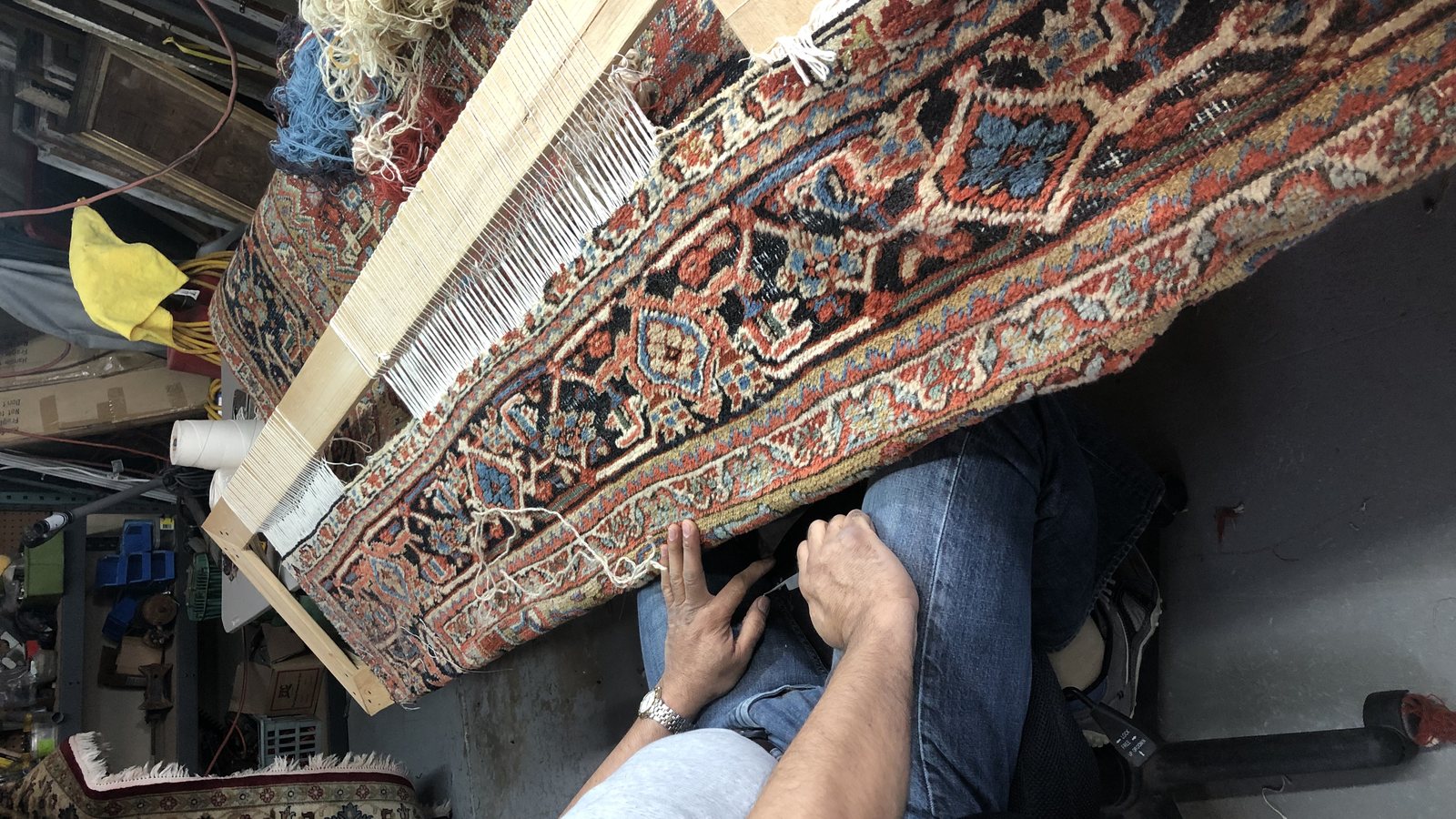
Matched wool being knotted back into an oriental rug at the repair bench
Matched wool being knotted into an oriental rug foundation at the repair bench.
What We Fix

Repair & Restoration Services

Everything from a quick fringe tidy to a corner rebuilt from nothing.

Fringe Repair & Replacement

What looks like a decorative fringe is the warp of the rug emerging at the ends. When it goes, the rug is losing structure from the edge inward. The ends are locked off, missing warps replaced, and the fringe re-knotted or renewed to match the original.

Edge Binding & Serging

Side cords absorb what the field never feels: vacuum beaters, chair legs, and a rug dragged back into place across a hearth stone. Once a cord opens up, the knots beside it start letting go. The edge is rewrapped by hand in matched wool.

Reweaving & Hole Repair

Tears, burns and bare patches are put back a knot at a time. The ground is rebuilt first and the pile after it, matched against the field for fiber, color and knot density.

Moth Damage

Larvae work the wool from the back, which is why the first thing anyone notices is bare foundation showing through — and by then the infestation is live rather than historic. It is treated, and the grazed areas are rewoven afterward. The classic find here is a rug rolled up in an unheated attic, a spare room in a house that was shut for the winter, or the strip under a bed that nobody has moved in three years.

Pet Damage

Chewed corners, clawed edges, urine that has taken the dye out from below. Contamination comes out first, because repairs knotted into a contaminated rug are wasted work; then the structure goes back and the color is brought up where the original is gone.

Hearth & Ember Burns

A rug in front of a working fireplace collects spark holes along one edge, usually several small ones rather than a single obvious hole. Charred fiber is cut back to sound material and the burnt area is rewoven, foundation first, so the edge reads continuous again instead of scarred.

Color & Dye Correction

Sun-bleached bands where a window faces down a valley with nothing in the way, bleach spots, and dye that ran during a bad cleaning or a soaking. Where the wool itself is undamaged, color is rebuilt by hand.

Resizing & Reshaping

Rugs shortened to fit a room, and rugs pulled back to square after years of buckling. Where an edge has been cut, it is finished properly, so the rug reads as a considered size and not as a piece of something bigger.

Backing & Foundation Repair

Latex that has broken down in a hand-tufted rug, cotton warps gone brittle in an old piece, and rugs that ripple because the foundation underneath has failed. Nothing cosmetic happens until the structure is sound.

Rug Pads & Prevention

More of these repairs than you would think begin with the wrong pad underneath. We fit breathable, non-adhesive pads sized to the rug — which matters most on a below-grade slab or over an old crawlspace, where a solid rubber pad traps moisture underneath and holds it against the foundation for months.

Local Conditions

What Asheville Air Does to a Rug’s Foundation

A rug in Asheville lives in two climates. It spends 171 days a year at or above 75% relative humidity — the level where mold becomes possible on wool and cotton given time — and then 81 nights a year below freezing, with the heating on and indoor air far drier than anything the rug saw in the warm half. The foundation tracks both, slowly, and what breaks is where the two disagree.

171
Days a year at or above 75% relative humidity
25
Longest unbroken damp run, in days
81
Nights a year at or below freezing
37.2
Inches of rain a year

A long heated winter is its own damage

81 nights a year below freezing, 9 of them below twenty degrees, means a furnace running for months on end.

Heated indoor air in that kind of winter sits far below the moisture content the rug spent the warm season's 171 damp days adjusting to, and the foundation contracts as it gives that moisture back.

Old cotton warps go brittle when they are dried hard and repeatedly, and a brittle warp snaps under a vacuum beater rather than stretching.

That is a different job from a rotted rug: the broken row has to be rebuilt before anything can be knotted back into it.

Where the house puts the rug

Grove Park, Kenilworth and Haw Creek are built on slopes, and water travels through a slope instead of sitting on top of it.

37.2 inches of rain a year tracks downhill and arrives at the uphill wall of the lowest room — which, in a house that steps down its lot, is usually the room where a demoted rug ended up.

North Asheville and Haw Creek run to finished lower levels, and a floor below grade is always the coldest surface in the house.

Moisture in the air goes to the coldest surface it can find, so a rug laid on that floor is wetted from underneath and dried from above at the same time and never reaches equilibrium. On 171 days a year the air has enough moisture in it for that to matter.

The oldest housing on the collection route goes back to the 1870s, and construction of that age was not built to keep ground moisture out of the rooms above it — which is worth remembering before blaming a rug's condition on the rug.

What that actually sends in for repair

Rugs that will not lie flat

A foundation that takes up moisture over 171 damp days and gives it back over 81 freezing nights of heated indoor air changes dimension twice a year, and wool and cotton do not change by the same amount.

The result is ripple, buckling and a rug that has quietly gone out of square; it is corrected by washing and blocking back under tension, not by moving the furniture.

Foundation loss, not surface wear

Cellulose held damp loses strength, and 25 unbroken days above 75% is long enough for it to matter.

A foundation going that way gives no cosmetic warning, so the test is mechanical: fold a corner and see whether it flexes or crackles, and pull gently on a fringe tassel to see whether it is still anchored in anything.

Warps that snap instead of stretching

9 nights a year below twenty degrees means long spells with the heating on hard, and old cotton that is dried like that repeatedly turns brittle.

Brittle warps break rather than give, usually under a vacuum beater or a chair leg, and the repair is to rebuild the broken row before any pile can go back into it.

Figures above are from the ERA5 reanalysis record for the five years from 2021 through 2025, taken at the center of the Asheville service area. If what you are seeing on your rug matches any of this, send photographs and we will tell you which of these it is.

Wet Rug Service

Flood, River Water & Water Damage Rug Restoration

The French Broad or the Swannanoa out of its banks, a hillside pushing through a basement wall after a wet week, a supply line behind a washing machine, or a pipe that froze on the north side of the house in January. The rug on that floor is now on a clock.

Why speed matters more than anything else

Wool takes a soaking better than almost anything else that lies on a floor. What it will not take is staying soaked. Heat the room and mold has the foundation inside roughly forty-eight hours; once it is down among the knots, no vacuum, spray or fan will reach it. A cold room is not a reprieve either — it slows the clock and removes every drying force at the same time, which is why a wet rug on a lower level cut into the hillside usually ends up in worse condition than one soaked upstairs. All the while the dyes are migrating, the cotton warp is rotting, and whatever the water brought in with it is curing in place.

River water is worse again. Flood water carries silt, sewage, fuel and whatever was in the yards, roads and garages it crossed, and the fine sediment it leaves behind sits at the base of the pile grinding against the knots long after the rug feels dry. That has to come out in immersion. Blowing air across a wet rug does not restore it: it dries the part you can see, seals the rest into the foundation, and buys about three weeks of the rug smelling normal.

What to do before we arrive

  • Get it up off the wet floor and clear of the furniture. Wooden legs standing in a damp pile bleed stain into the wool within hours.
  • No tight plastic wrapping. Sealed wet wool is an incubator. Loose and open to the air is better.
  • Photograph the rug wet and where it sits, before anything is shifted. Your carrier will want it.
  • Do not hose the silt off and stand it in the sun. Half-washing sets the contamination and sunlight bleaches wet dye fast.
  • Do not carry a soaked rug alone. Wet wool holds a great deal of water and a nine-by-twelve becomes genuinely dangerous on stairs.

The restoration sequence

  • Priority collection. A soaked rug is taken ahead of routine washing wherever the schedule permits.
  • Category assessment. Clean supply water, gray water and river or flood water are three separate jobs, and the answer decides the method.
  • Extraction and full flush. Silt and contamination are carried out through the foundation rather than shut in under a dry face.
  • Antimicrobial treatment. Taken through the entire rug, front and back, before drying begins.
  • Monitored flat drying. Filtered moving air over a flat rug, metered until the readings stop dropping, so nothing goes home damp.
  • Dye-bleed correction. Color that ran while the rug was saturated is pulled back as far as the wool will let it go.
  • Structural repair. Rewoven foundation and pile, once the rug is dry and stable enough to work on.
  • Claim documentation. Photographs from intake onward, and a written condition report for your carrier.
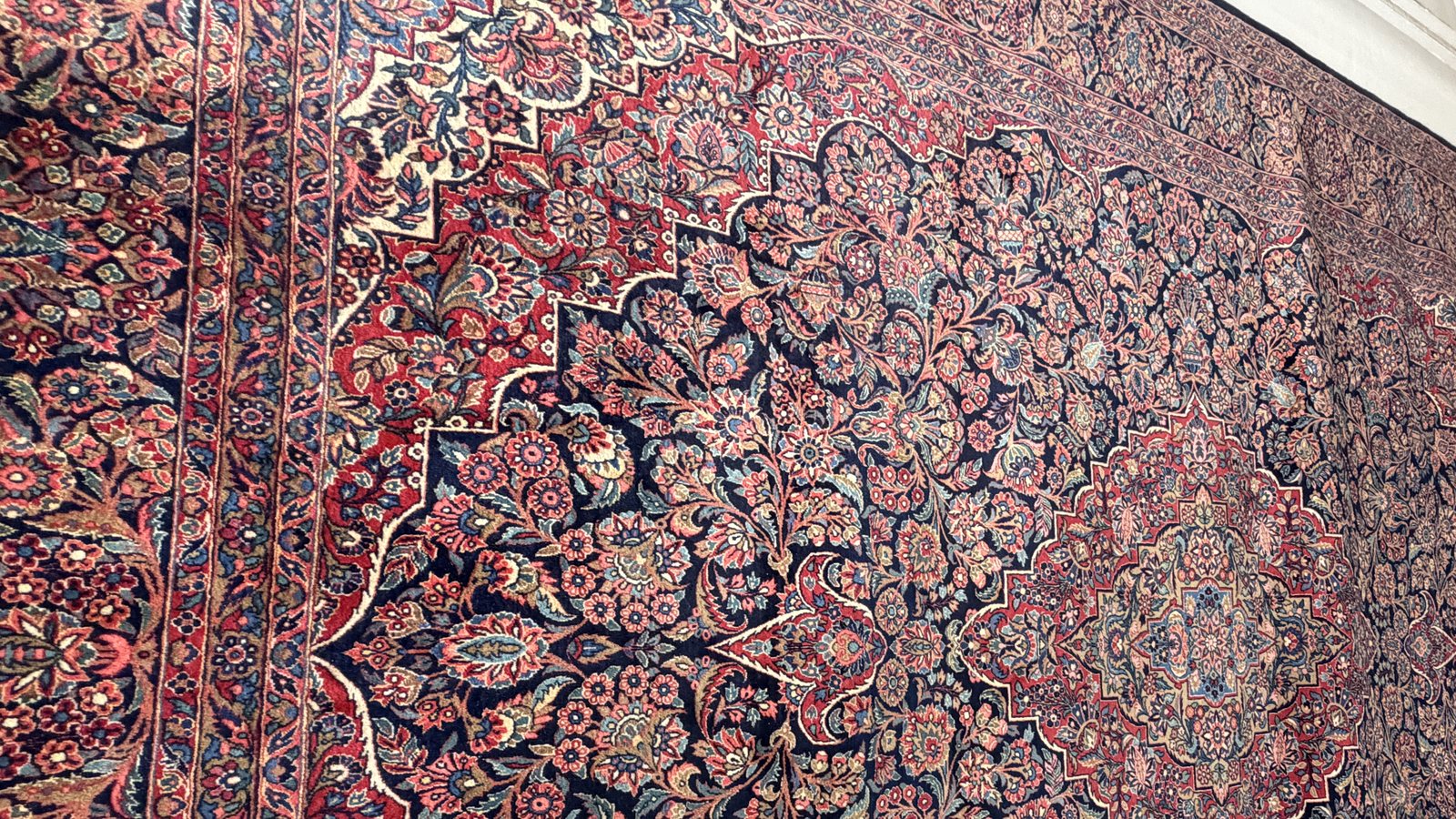
A rug photographed flat after water-damage recovery, field color brought back through the pile
How It Works

From First Message to Delivery

Photos or Collection

Send pictures of the damage, or we collect the rug at no charge anywhere across Buncombe and Henderson counties.

Assessment & Quote

Damage is mapped, materials identified, and a written price reaches you with the options on it. Nothing proceeds until you agree to it.

Clean First

Repairs go onto a clean rug. Working new wool into a sooted field leaves a visible bright patch a year later.

Materials Matched

The wool is chosen against the original by fiber, weight and dye lot, and held against the field to check it before anything is tied in.

Hand Repair

Ground rebuilt first, knots tied in at the original density, and the new pile sheared back to the height beside it.

Final Check & Return

Groomed, held against the intake photographs, and delivered back to the room.

Questions

Repair & Restoration FAQ

Is my rug worth repairing?
The answer comes before the work, not after it. A repair makes sense where the rug has value — sentimental or financial — and where the structure underneath is still holding. If the cost of putting it right approaches what the rug is worth, we say so and leave the decision with you.
How long does rug repair take?
It depends on how much ground has to be rebuilt, because reweaving is hand work measured across square inches. A timeline comes with the written quote and before any commitment from you. Wet rugs are the exception and go straight into the process, because with those it is the waiting that does the damage.
Can a rug that took river flooding be saved?
More often than people expect, yes. What decides it is how fast the rug is flushed, not how alarming it looked on the day. Flood water needs immersion to get the silt and the contamination out of the foundation, and mold takes hold in saturated wool within about forty-eight hours. Ask before anything goes to the curb.
Can spark burns from the fireplace be repaired?
Yes, and they are one of the more satisfying repairs to do. A burn is a small, clearly bounded loss: the charred fiber is cut back to sound material, the foundation is rebuilt across the gap, and the pile is knotted in and sheared level. A row of small burns along a hearth edge takes longer than one large hole, because each one is its own repair, but the result is a rug that reads continuous again.
Will the repair be visible?
Not once the pile has been groomed, unless you already know where to look. The wool is matched on fiber, dye lot and knot density, and the ground is rebuilt before the pile, so the repair wears down at the same rate as everything beside it.
Do you work with insurance claims?
Yes. Photographs are taken at intake and throughout, and the written record of damage, treatment and value impact goes to you to submit.
My rug ripples and will not lie flat. Can that be fixed?
Usually. Buckling comes from an uneven foundation, from bad drying somewhere in the rug's past, or from a cotton warp that has spent years swelling through damp summers and contracting through dry wood-heated winters. The cure is a wash, blocking back to square under tension, and repair of the foundation wherever it has pulled or torn.

Send Us a Photo. We Will Tell You Straight.

Free assessment on every repair, and a straight answer about whether it is worth the work.

Rug Cleaning

The six stages every rug goes through, and why washing one in the room it lives in does not work up here.

Cleaning process

Asheville Care Notes

Mountain damp, wood heat, leaf tannin and lower floors cut into the hill — what rug owners here need to know.

Care notes

Book a Collection

Collection and delivery included across Buncombe and Henderson counties.

Contact us
Start a Free Estimate Service Areas