Now booking: collection runs from Weaverville down to Fletcher — start an estimate
Serving the Blue Ridge
Rug Cleaning

Professional Rug Cleaning in Asheville

Every rug is washed by hand, off site — not cleaned in place with a wand over your heart-pine floor, and never run through a machine that treats silk like a doormat.

The Difference

Why Rug Cleaning Is Not Carpet Cleaning

Wall-to-wall carpet is tacked and stretched across a pad. The backing seals it, water drains down into the pad below, and it will take a good deal of punishment. An area rug works the other way round entirely: open front and back, resting straight on the floorboards, and often held together by hand-tied knots on a cotton warp a century or more old.

A wand run across a rug in the room it lives in does three things, none of them good. The soil at the base of the pile is driven downward instead of drawn out. Water goes into the foundation with nowhere to go, and in a climate where the air outside is cool and wet for most of the year, that becomes a musty rug rather than a clean one. And the floor underneath — here that is very often old wood over a crawlspace, or a slab on a lower level with earth behind the wall — is already carrying its own moisture, so nothing dries downward.

Washing away from the house avoids the lot of it. The rug leaves, the dry grit and ash come out before any water is introduced, it is washed and rinsed until the water runs clear, and it dries flat under moving air. Then it comes home.

Learn how rugs are constructed

A clean wool rug hanging on the drying rack after washing
A finished wool rug hanging to dry, pile lifted and colors back.
Step by Step

The Cleaning Process

Six stages, in this order, no exceptions. Skipping one is how rugs get ruined.

Inspection & Dye Testing

Opened out flat and examined from both faces. Fiber and construction are identified, damage already present is written down, and each color is swabbed to see whether it holds. The findings set the wash plan, and you are told what they were.

Dry Grit & Ash Removal

Before water, the dry soil comes out. A rug in a house up here holds mineral grit off a gravel drive, wood ash from the hearth and dust down at the foundation. Dusting with compressed air and controlled beating shakes the lot loose. For sheer effect on how long a rug survives, nothing else comes close.

Pre-Treatment

Spots, pet accidents, leaf tannin, mildew blooms and traffic lanes are handled one at a time, with chemistry matched to the fiber and given dwell time. Wool and silk are kept at neutral pH; synthetics will tolerate more.

Full Immersion Wash

Into the water, and washed by hand with soft brushes run along the pile, so the soil that has been loosened floats away rather than being ground back down. Immersion is also what carries fine combustion particulate back out of the fiber, which no surface method does. Anything delicate, or carrying an unstable dye, is handled low-moisture.

Rinse & Controlled Drying

Flushing goes on until the water runs clear; detergent left in a rug pulls new soil straight back to it. The water is then extracted mechanically and the rug dries flat in moving filtered air. Never in sun, which fades dye and hardens wool.

Grooming & Final Check

The pile is groomed back the way it lies, the fringe is cleaned and straightened, and the rug is compared against the intake notes. Anything that did not resolve is flagged before wrapping.

Recent work

Before and After

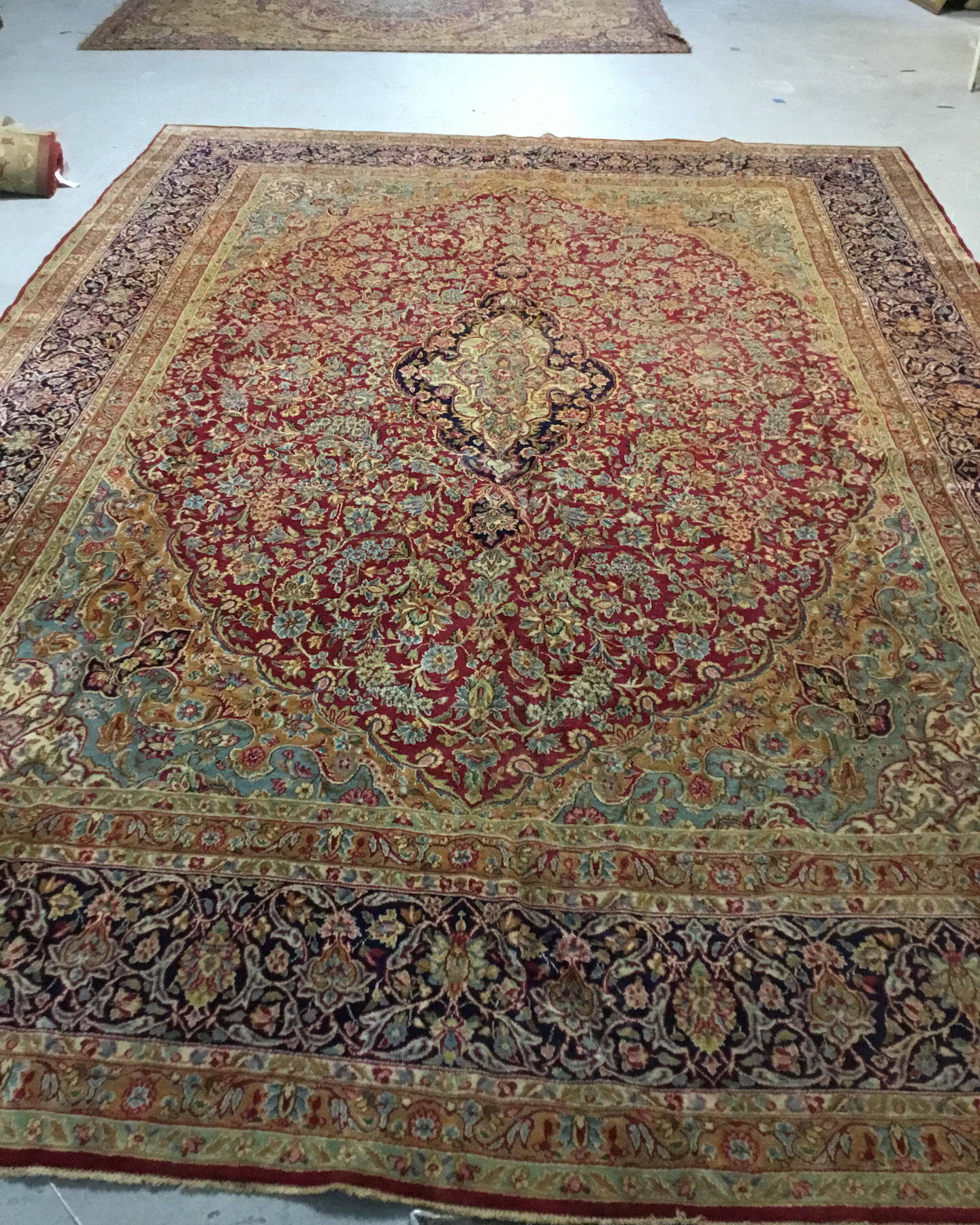
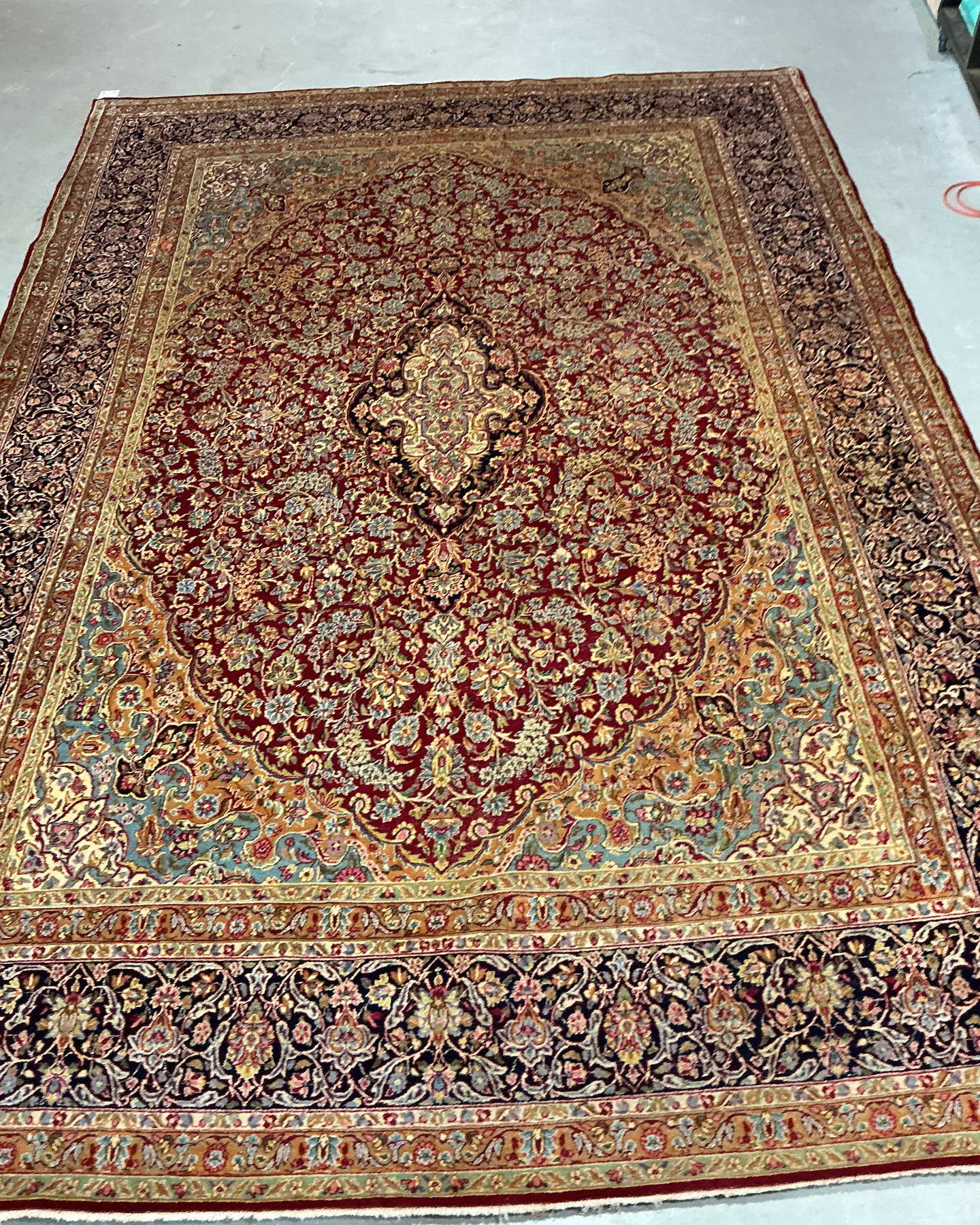
One hand-knotted Persian rug, photographed before and after cleaning.

Before
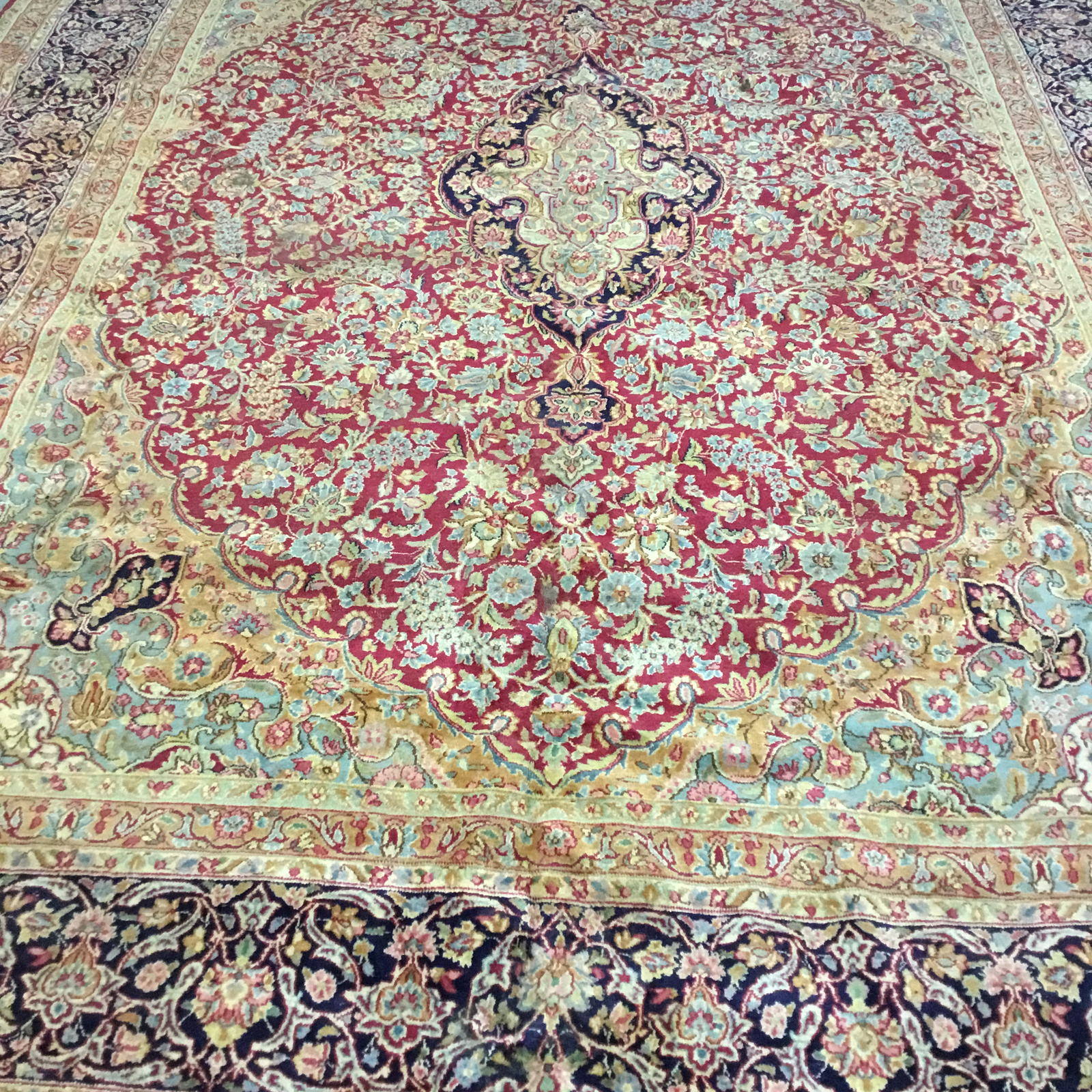
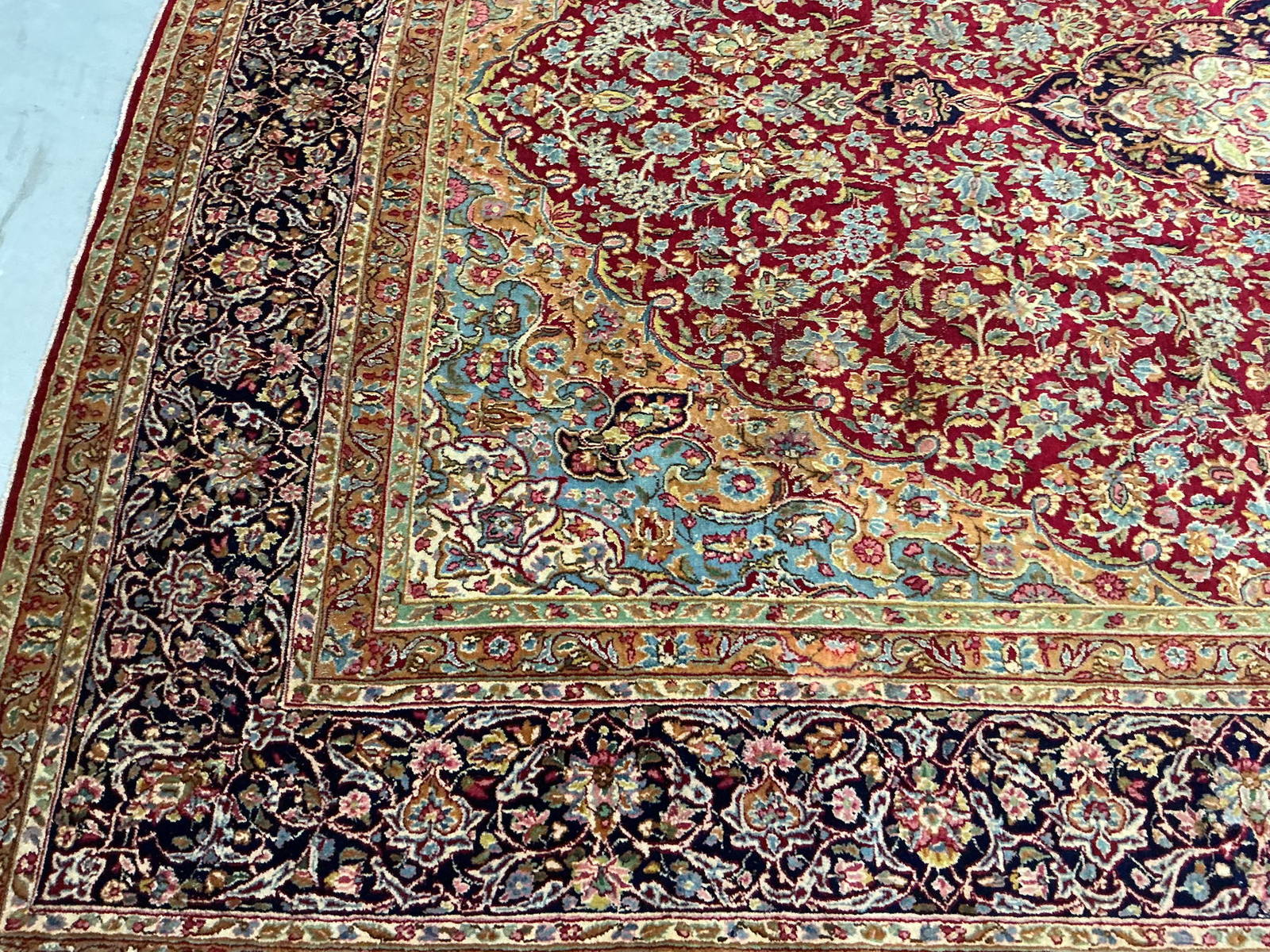
Hand-knotted Persian rug before cleaning, the deep red field and blue-green floral tracery muted and greyed
After
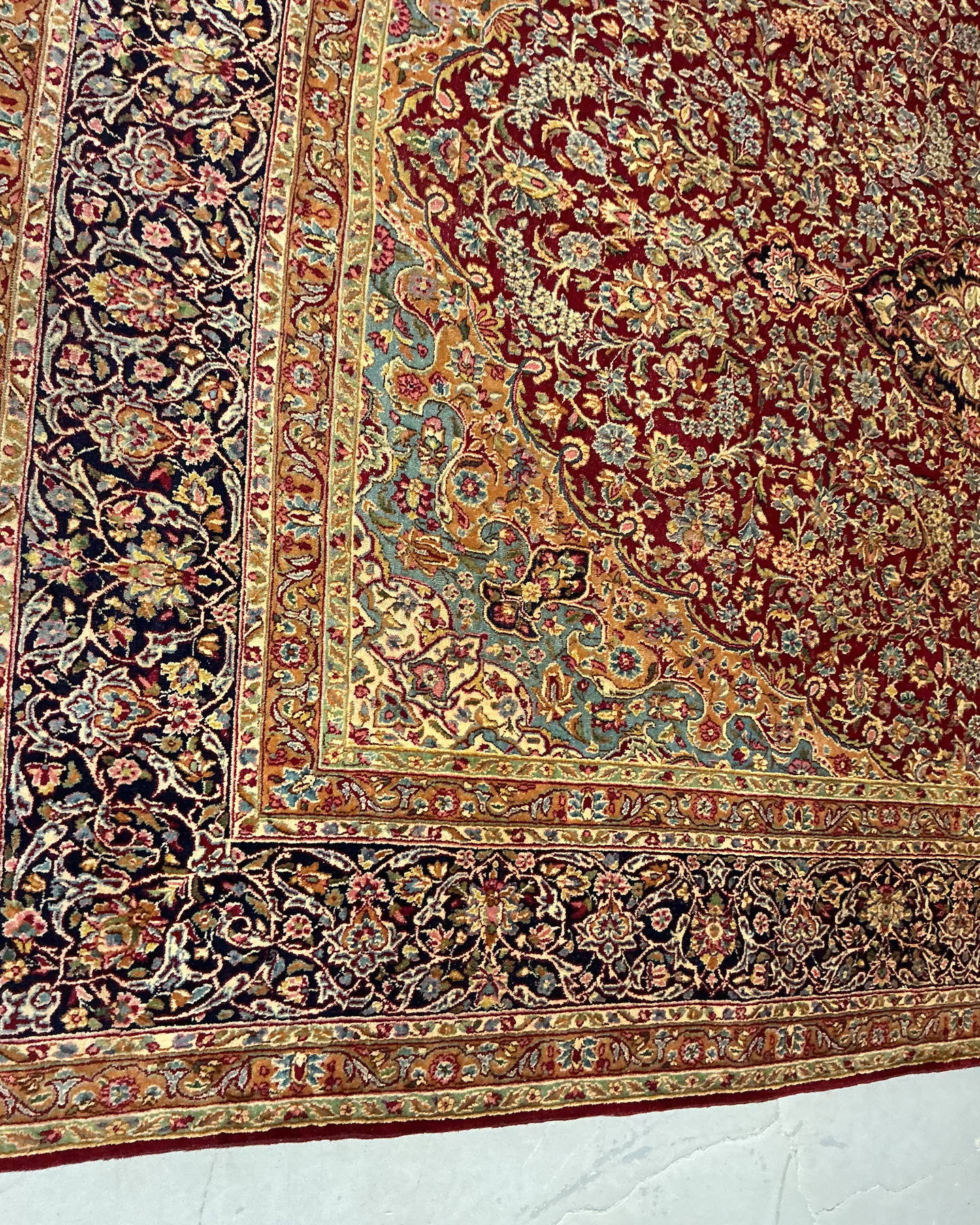
The same rug after cleaning, with the red field, gold corner spandrels and blue-green florals showing clearly
A hand-knotted Persian, before and after cleaning.
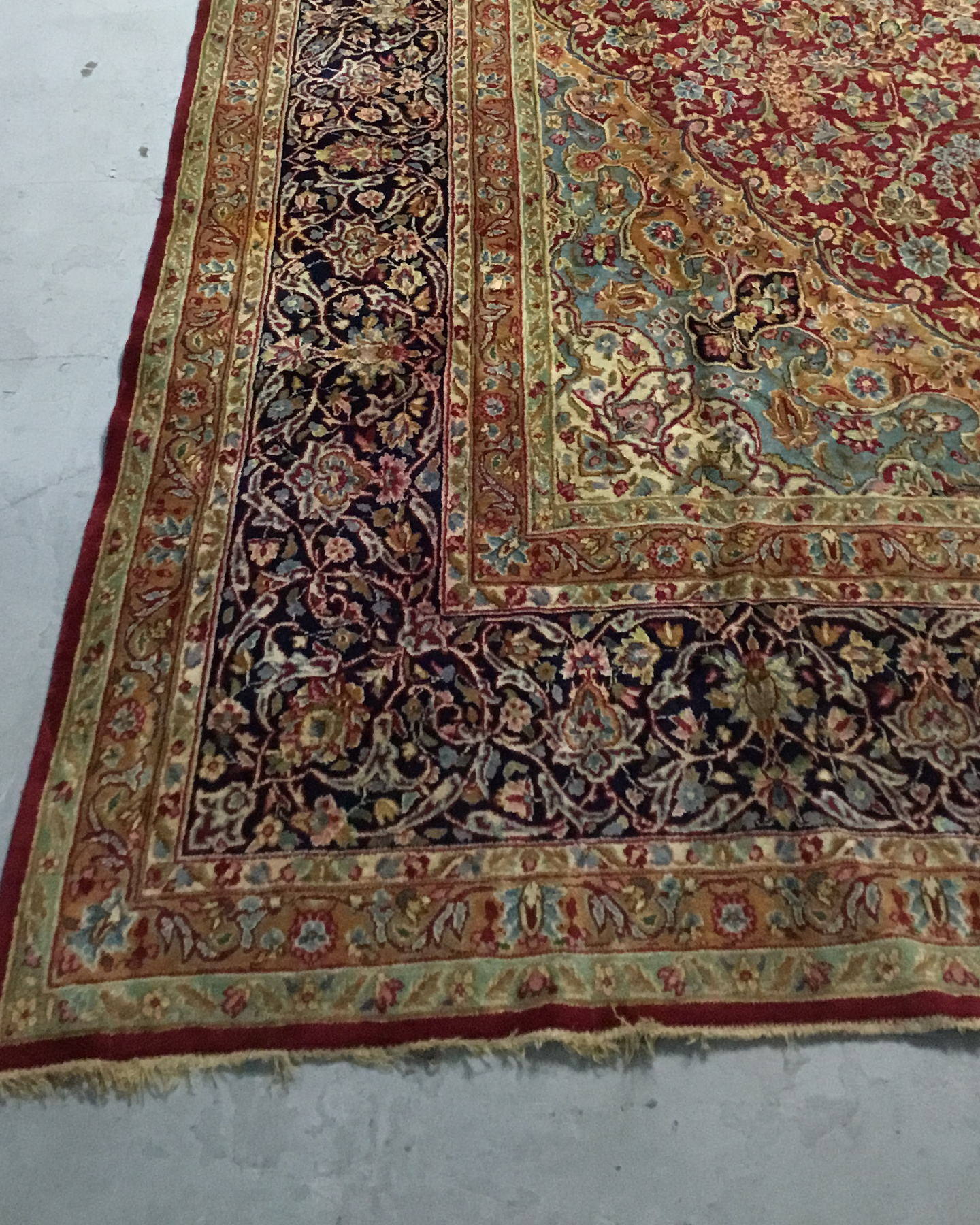
Before
Corner of the same rug before cleaning, the navy border and ivory fringe dulled and flattened in tone
After
The same corner after cleaning, with the navy border, gold guard bands and ivory fringe distinct again
Corner detail — border, guard stripes and fringe.
Before
Centre of the same rug before cleaning, the navy medallion and red field hazy and low in contrast
After
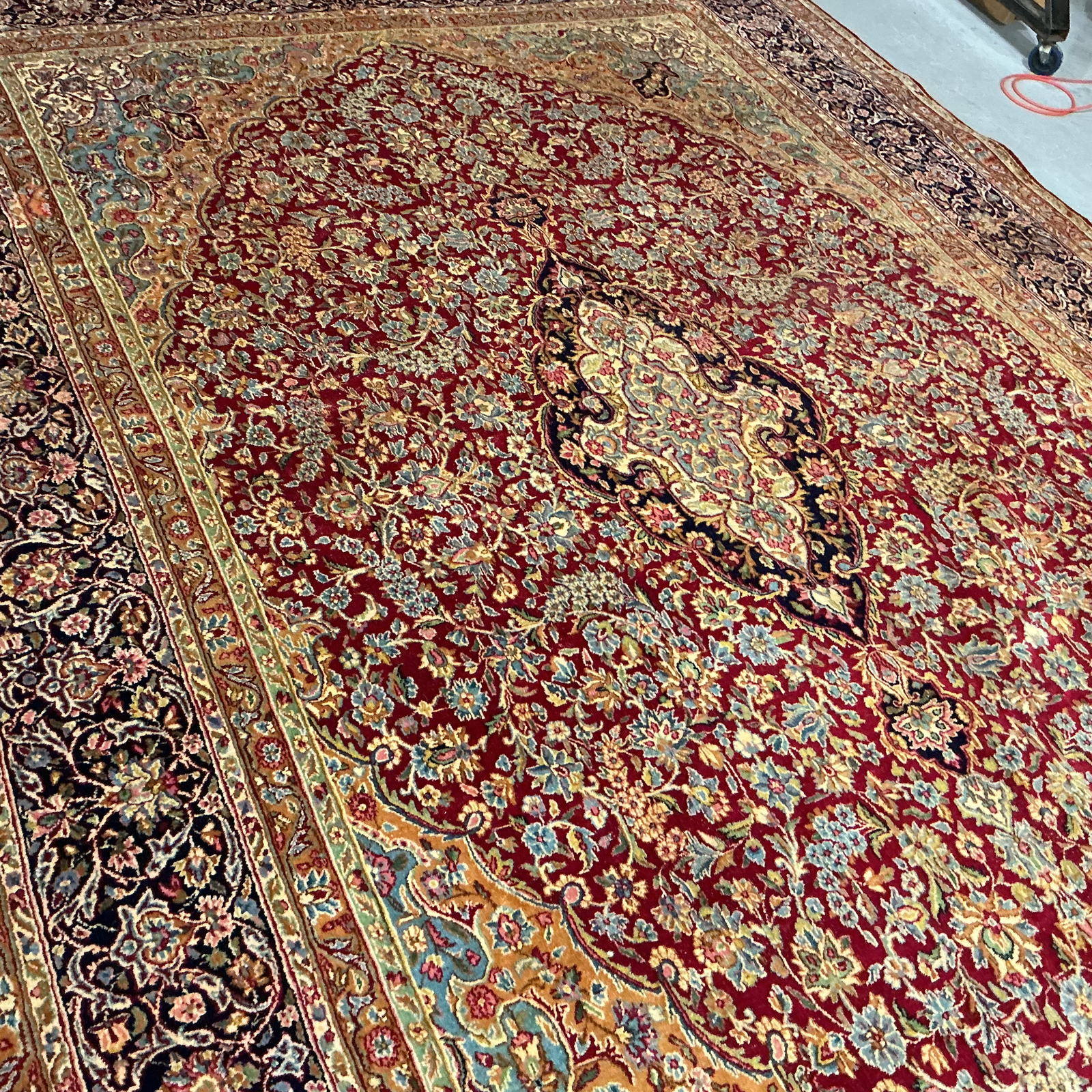
The same medallion after cleaning, the cream and gold palmette reading crisply against the navy and red
The central medallion and the field around it.
Before
Field meeting border on the same rug before cleaning, the blues and pinks greyed and indistinct
After
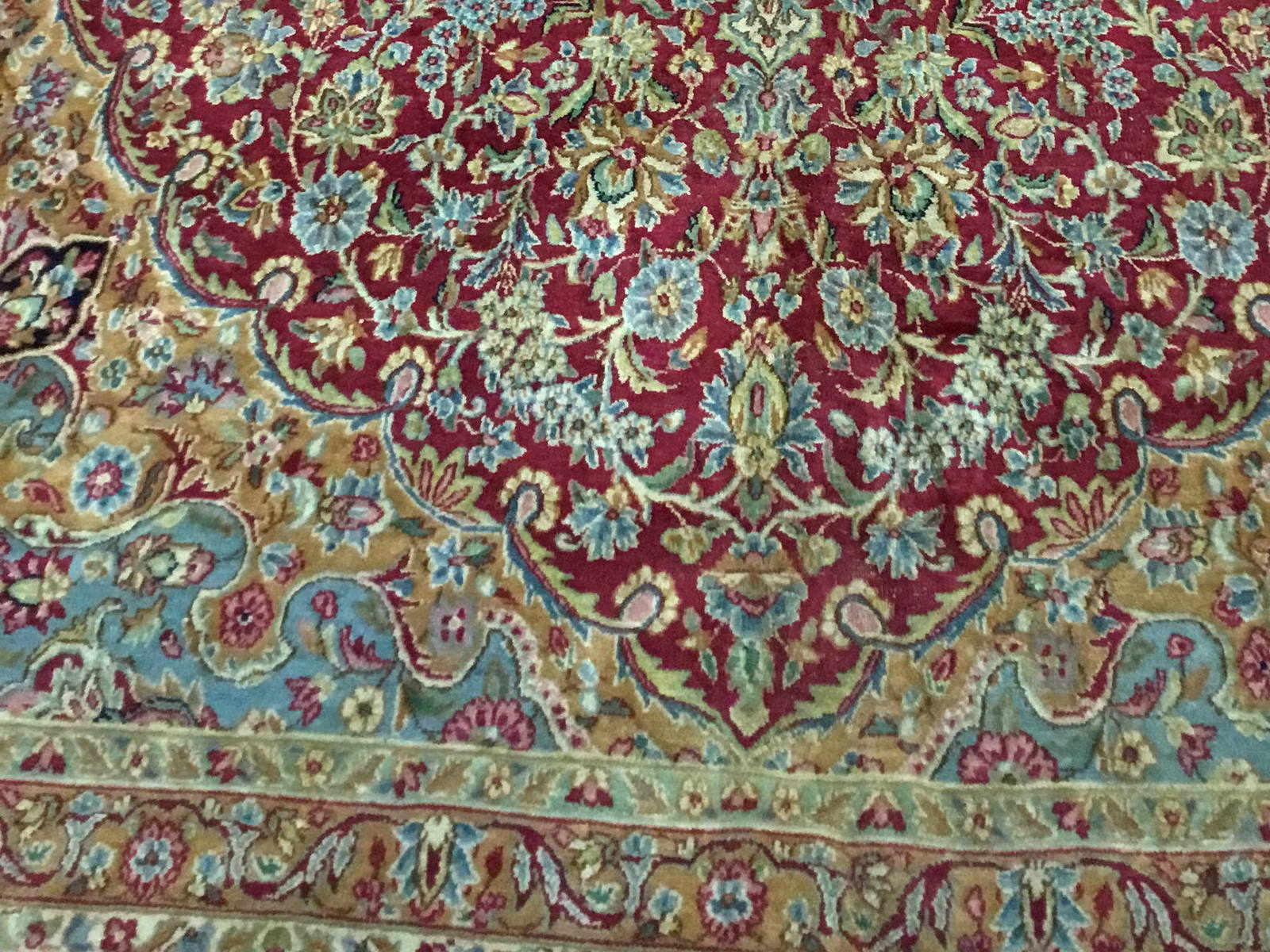
The same section after cleaning, with the pale blue scrollwork and pink florals separated and legible
Where the field meets the border.
Local Conditions

Drying a Rug in Asheville Air

Asheville gives a rug 171 damp days and 81 freezing nights a year, which is two completely different drying environments in the same house. Knowing which half of the year a rug has been sitting through changes what we expect to find in it before it is even unrolled.

72.9%
Mean relative humidity, five-year average
112
Days a year at or above 80% relative humidity
25
Longest unbroken damp run, in days
128
Days a year with measurable rain

The dry window is the cold half of the year

81 freezing nights a year mean months of heated indoor air that is far drier than anything the rug sees in summer, so winter is when a Asheville house dries a rug best and summer is when it dries one worst.

That is worth knowing if a rug has been waiting: the 171 damp days are not evenly spread, and neither is the sense of leaving a rug on the floor while you decide.

Why it cannot dry where it lies

A rug washed in the room it lives in has to give its water back to that room's air, and for 25 days at a stretch Asheville air is already at or above 75%.

Air that damp takes water out of a rug slowly at best, which is the whole problem with in-home wand cleaning here: the pile dries, the foundation does not, and the rug smells fine for a few weeks and then does not.

Rain, and the trip to the workshop

128 days a year here see measurable rain, totalling 37.2 inches, so a rug leaving the house is wrapped for the weather rather than for the look of it.

It is also why we would rather collect a wet rug than have it wait: a rug that is already damp when it is rolled is in the worst possible condition for sitting still.

The floor the rug goes back onto

In the sloped lots around Grove Park, Kenilworth and Haw Creek, the lowest room in the house is where rain ends up, and it is usually where the second-best rug lives.

Those rugs come in smelling of the room rather than of themselves, and the honest conversation is about the floor as much as the rug.

Rugs collected from the finished lower levels common in North Asheville and Haw Creek are the ones most often mistaken for permanently ruined.

A below-grade floor keeps feeding moisture back into anything laid on it, so the question to settle before the rug goes home is whether the floor has been dealt with — not how thoroughly the rug was washed.

Housing on this route starts in the 1870s, so a fair number of these rugs are drying onto floors that are older than any vapor barrier — a detail worth settling before the rug comes back.

Humidity, rainfall and temperature figures are from the ERA5 reanalysis record for the five years from 2021 through 2025, measured at the center of the Asheville service area.

What We Accept

Rug Types We Clean

Anything that lies on a floor has a method that suits it. Each type is handled differently.

Fiber and construction, and what each of them needs from a wash.
Rug type How we handle it
Hand-knotted Persian & oriental Tested for dye, then washed by full immersion, fringe by hand. Older pieces are agitated less and dried longer.
Wool area rugs Neutral-pH immersion. Lanolin stays in the fiber instead of being washed out of it, which is what keeps wool shedding dirt.
Silk & art silk (viscose) Low-moisture handling, specialist throughout. Viscose yellows and stiffens when it is over-wet, so it is never immersed.
Cotton flatweaves & dhurries Tight moisture control through the wash, then dried under tension so the reversible weave stays flat and keeps its size.
Jute, sisal & seagrass Dry or very-low-moisture only. Plant fiber browns from its own water, and it is the first thing in a cool damp room to mildew.
Hand-tufted rugs Handled gently around the latex backing layer, which is the part that perishes with age and gives off that unmistakable glue smell.
Machine-made synthetics Polypropylene, nylon and polyester will take a full wash and a stronger pre-treatment, and they repay it handsomely.
Shag, hides & sheepskin Specialty work: agents chosen for the fiber, and hand finishing to bring the pile back up.
Local Specialties

Problems Asheville Rugs Actually Have

Mountain Damp & the Cupboard Smell

The trap here is that the weather is pleasant. A summer with a daily average under seventy-four degrees never asks the air conditioning to run, and an air conditioner is the only mechanical dehumidifier most houses have. Put a wool rug on a lower level with earth behind the wall, or over a crawlspace in a creek valley, and it spends months at a humidity it cannot dry at. What you eventually notice is a smell, and that smell is microbial growth down in the foundation. It comes out in the wash, with an antimicrobial applied behind it. Anything sprayed on top is gone by the next wet week.

Woodsmoke, Ash & Hearth Burns

Six months of a wood stove or an open fire lays fine combustion particulate across the whole rug rather than in one spot, so the field goes evenly gray and the owner reads it as the rug simply getting old. It is not age, and it does come out — but only in immersion, because the particles are down at the base of the pile. Ash and creosote also carry an odor of their own, and a hearth rug usually arrives with spark burns along one edge that are a repair job as well as a cleaning one.

Pet Urine, Mud & Leaf Tannin

Urine salts stay in the foundation and pull moisture back out of the air every time the humidity climbs, which up here is most of the year, and they burn dye if they are left. The dog brings the other half of it in: wet leaves and mountain mud off a wooded lot. Leaf tannin stains brown and sets, and it wants pulling out rather than bleaching over. All of it is flushed out, and the discoloration is corrected where the dye underneath came through.

How the Work Is Set Up

Washed Off Site, Flat

Collected, washed away from the house, and dried flat under moving air instead of being hung wet or dried on your floorboards.

Safe for Every Fiber

Fiber identification and dye testing happen first, before water. Neutral chemistry for wool and silk, and stronger treatment only where it can be used safely.

Collection & Delivery

Buncombe and Henderson counties, both ways, at no charge. Furniture is moved off the rug as part of it.

Plain Answers

What we find at intake, what it costs, and what will not shift — you get all three before anything begins.

Questions

Frequently Asked Questions

How long am I without the rug?
You get a timeline alongside the quote, before anything starts. Drying is the long part, and it runs longer here than in a hot climate, because the rug stays on the drying floor until it is actually dry. Heavy pet contamination, dye bleeding or repair work extend it, and that is said at the outset rather than afterward.
Can you collect from a house nobody is living in?
Yes — it happens constantly in this market. Plenty of rugs come out of summer houses, cabins and rentals through a property manager, a caretaker or a neighbor with a key, and go back before the owner returns. Tell us in the form who holds access and we will fit around it. Condition is photographed when the rug is collected, so there is a record of it before it goes.
Is there anything you will not clean?
Hand-knotted Persian and oriental, wool, silk, cotton flatweave, jute and sisal, hand-tufted, machine-made synthetic, hide and shag. Each fiber is washed its own way, and a small number — antique silk especially — get low-moisture treatment and nothing else.
Is collection and delivery actually free?
Yes, across Buncombe County and Henderson County. We collect, move the furniture off the rug, and bring it back rolled and ready to put down. Neither leg is charged for.
Will a wash shrink the rug or bleed the colors?
Not when the method fits the rug. Every color is dye-tested before any water arrives, and an unstable dye means low moisture or a dye-setting step. Shrinkage comes from soaking a cotton foundation and then drying it under tension, which is exactly what flat, controlled drying avoids.
How often should a rug be washed up here?
As a rule, twelve to eighteen months for a rug in a main living area, and nearer the short end of that if the room has a working fireplace or sits below grade. The reasons are local: rain spread right through the year, summers too mild for the air conditioning to dry the house out, a heating season that runs on wood in a great many houses, and lower floors built into a hillside. Guest rooms and lightly walked rugs will go two or three years. A rug that has been wet is dealt with straight away rather than eventually.
Can a musty smell be removed for good?
Usually. The smell is microbial growth down in the foundation, not on the surface, so it has to be flushed out in full immersion and then treated with an antimicrobial. A deodorizing spray only masks it, and it is back with the next damp stretch. Where the foundation has already started to rot, the question is a repair one as much as a cleaning one, and we will tell you which of the two you have.
What does rug cleaning cost?
Priced by the square foot, and it depends on fiber, construction and condition — a machine-made synthetic and a hand-knotted silk are not comparable jobs. The quote comes first, the estimate is free, and nothing is added afterward. Send the details and we will come back to you with a figure.
Get In Touch

Book a Collection

Say roughly what you have and where you are, and it goes on the next run out.

  • Service area
    Buncombe County and Henderson County, North Carolina
    Collection & delivery included throughout
  • Hours
    Mon–Sat: 9:00 AM – 5:00 PM
    Sunday: Closed

Free Cleaning Estimate

Up to 6 photos. Close-ups of any damage, stains or wear help us quote accurately without a visit.

Ready for a Cleaner Rug?

Free estimate, collection included, and a rug that looks the way it did when you first put it down.

Rug Repair & Restoration

Fringe, binding, moth grazing, hearth burns and reweaving — what can be fixed and what it involves.

Repair services

Flood & Water Damage

What to do in the first forty-eight hours after a rug takes river water, hillside seepage or a leak.

Water damage

The Rug Owner’s Guide

Knots, fibers, construction, and how to care for all of it through a Blue Ridge year.

Read the guide
Start a Free Estimate Service Areas